
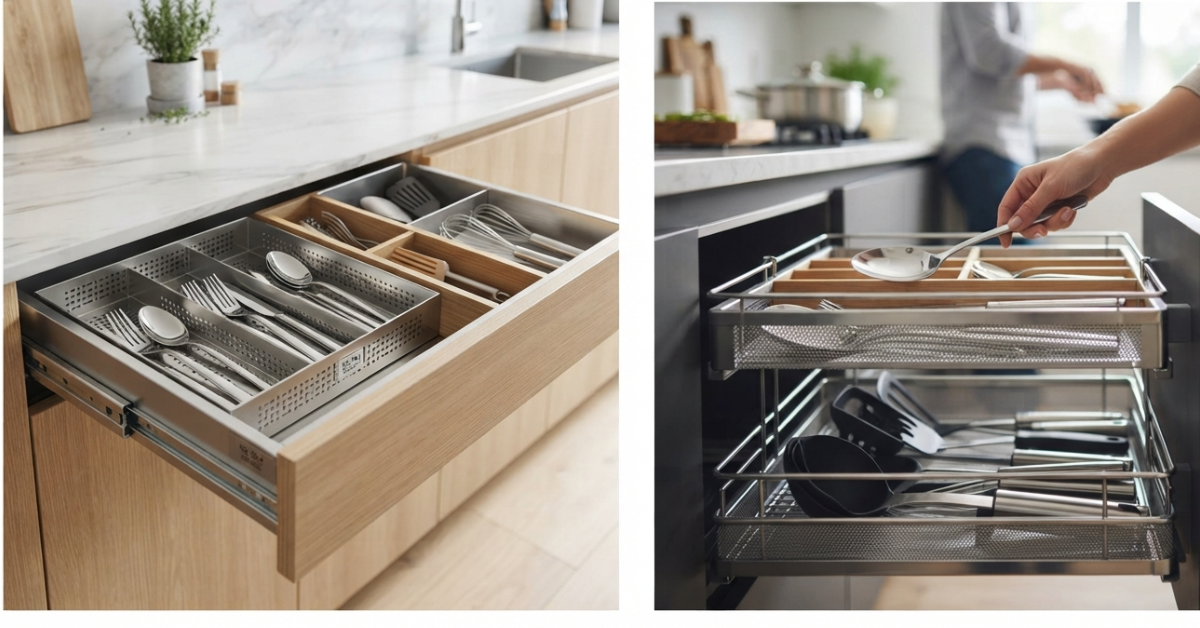
An organized kitchen begins inside your base cabinet drawers, where spoons, forks, chef knives, and traditional prep tools frequently vanish into chaotic piles. Installing a dedicated SS 304 cutlery basket transforms deep, cluttered drawers into structured, hygienic prep stations that streamline daily cooking workflows. This comprehensive guide breaks down top cutlery storage ideas, material standards, drawer dimensions, and smart modular upgrades to help you choose the perfect organizer for your home.
Top Cutlery Basket Types & Features
Selecting the right cutlery organizer requires matching your drawer depth and utensil volume with the ideal basket construction.
Below is a direct breakdown of the four main cutlery basket types used in contemporary kitchens.
1. Wire Mesh Cutlery Baskets
Wire mesh models feature open-lattice stainless steel framing that promotes maximum airflow, preventing moisture build-up after washing.
- Best For: Daily family cutlery, tea spoons, and standard dining forks.
- Key Advantage: Fast air-drying prevents water spots and bacterial growth on wet utensils.
- Ideal Drawer Depth: 4 inches to 6 inches base cabinet drawers.
2. Perforated Sheet (Perfo) Cutlery Baskets
Perforated steel inserts feature solid bottoms with laser-cut ventilation patterns, preventing small items like tea strainers and corn picks from slipping through gaps.
- Best For: Mixed utensil collections, small baking accessories, and sharp steak knives.
- Key Advantage: Smooth sheet surface prevents blade tips or thin handles from catching during drawer pull-out.
- Ideal Drawer Depth: 6 inches standard modular drawer profile.
3. Multi-Tier Adjustable Cutlery Trays
Multi-tier designs utilize a sliding upper tray over a deep base basket, doubling vertical storage density within a single drawer carcass.
- Best For: Compact kitchens requiring maximum utensil storage within minimal horizontal counter width.
- Key Advantage: Separates daily eating cutlery on top from heavy serving ladles and whisk attachments below.
- Ideal Drawer Depth: 8 inches deep base cabinet pull-outs.
4. Modular Wooden and SS Hybrid Dividers
Combining removable stainless steel cutlery cups with moisture-resistant wooden framing delivers high aesthetic appeal and customizable compartment sizing.
- Best For: Premium modular kitchen builds and custom architectural cabinetry.
- Key Advantage: Adjustable dividers shift horizontally to accommodate oversized bread knives or barbecue tongs.
- Ideal Drawer Depth: Standard 500 mm depth cabinet systems.
Technical Specs: SS 304 vs Secondary Metals
The internal cabinet environment exposes hardware to continuous humidity, steam, and acidic spice residues like salt and turmeric.
Evaluating structural build quality before purchase ensures long-term smooth operation.
| Feature / Property | Grade SS 304 Stainless Steel | Chrome-Plated Mild Steel | Anodized Aluminum Alloy |
| Chemical Composition | 18% Chromium, 8% Nickel | Iron core with thin electro-plate | Oxidized Aluminum alloy frame |
| Rust & Corrosion Resistance | Exceptional; self-healing oxide layer | Poor; chips and rusts under moisture | Moderate to High; non-ferrous structure |
| Average Weight Load Capacity | 25 kg – 35 kg heavy-duty rating | 10 kg – 15 kg maximum load | 15 kg – 20 kg medium rating |
| Runner Mechanism Compatibility | Soft-close telescopic hydraulic slides | Basic ball-bearing side runners | Undermount concealed soft-close slides |
| Expected Service Life | 15+ Years under daily residential use | 1 – 3 Years before surface degradation | 8 – 10 Years under dry storage |
The Science of SS 304 Corrosion Prevention
Grade SS 304 stainless steel contains a minimum 18% chromium content. When exposed to oxygen, chromium forms an invisible, self-healing chromium oxide film across the basket surface.
This micro-layer blocks water molecules and salt ions from reaching the underlying iron, completely stopping rust formation even in coastal or high-humidity tropical microclimates.
Soft-Close Telescopic Runner Integration
High-performance cutlery baskets rely on heavy-duty side-mount or undermount telescopic channels equipped with hydraulic dampeners.
Soft-close mechanisms absorb impact force when drawers are pushed firmly, preventing metal utensils from slamming together, rattling, or falling out of designated divider channels.
Pro Tip: Always verify that your cabinet installer uses full-extension telescopic slides. Partial-extension slides leave the rear 4 inches of your cutlery basket buried inside the dark cabinet carcass, rendering back compartments virtually inaccessible.
Why Modern Kitchens Require Purpose-Built Cutlery Storage
Unorganized drawers create subtle friction points that slow down daily meal preparation and compromise household hygiene.
Upgrading to a dedicated modular cutlery basket resolves these core operational challenges.
[Unorganized Drawer Chaos]
│
├── Utensil Friction & Blunting ──► Blades dull from colliding with metal spoons
├── Cross-Contamination Risk ──► Wet items trap moisture in solid wooden bases
└── Wasted Cooking Time ──► Searching 2-3 minutes per meal for specific tools
│
▼
[Modular Cutlery Basket Integration]
│
├── Segmented Compartments ──► Dedicated slots protect sharp edges & handles
├── Open Matrix Ventilation ──► Rapid air-drying prevents mold & corrosion
└── Single-Motion Accessibility ──► Full visibility cuts prep time significantly
Eliminating Cross-Contamination and Bacteria
Storing damp utensils inside solid wooden drawers or non-vented plastic trays traps moisture pockets.
Dark, humid drawer environments foster mold growth and bacterial accumulation.
Stainless steel wire and perfo cutlery basket systems allow moisture to drain immediately onto removable lower drip trays, ensuring rapid drying and immaculate food safety standards.
Protecting Sharp Culinary Edges
High-carbon chef knives lose their razor-sharp bevels when tossed loosely into general drawers alongside stainless steel forks and metal tongs.
Purpose-built cutlery inserts keep knife blades isolated in vertical slots or soft-padded grooves, preserving blade geometry and eliminating accidental hand cuts when reaching into drawers.
How to Measure Cabinet Carcasses Accurately Before Purchase
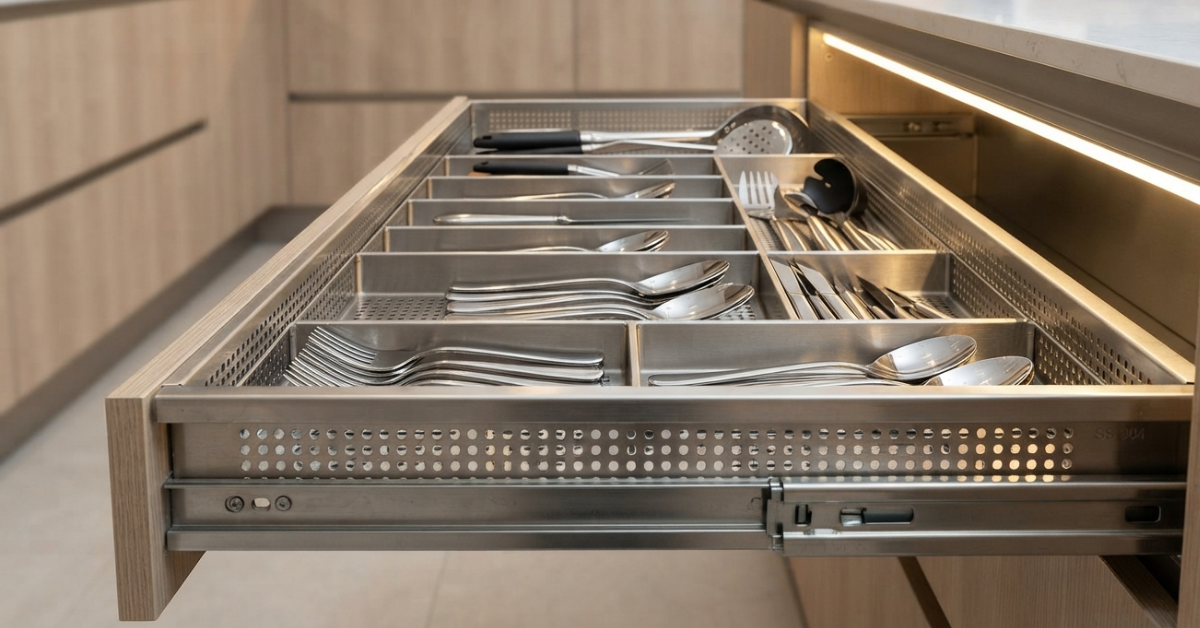
Inaccurate cabinet carcass measurement is the primary reason homeowners purchase incompatible hardware.
Follow this precise three-step measurement protocol before selecting your basket dimensions.
Cabinet Carcass Opening Width (Side-to-Side Inner Wall)
◄────────────────────────────────────────────────────────►
┌────────────────────────────────────────────────────────┐ ▲
│ │ │
│ Internal Cabinet Carcass │ │ Internal
│ │ │ Depth
│ Basket Unit Width = Carcass Width minus Slide Gap │ │ (Front-to-Back)
│ (Subtract 25 mm – 38 mm total for side runners) │ │
│ │ │
└────────────────────────────────────────────────────────┘ ▼
Step 1: Measure Internal Clear Carcass Width
Open your cabinet door or remove the existing drawer box completely.
Measure the exact distance between the inside surface of the left cabinet sidewall and the inside surface of the right cabinet sidewall.
Record measurements in millimeters at both the front frame and the rear wall to detect carcass bowing.
Step 2: Account for Slide Hardware Tolerances
Standard side-mounted telescopic runners require exactly 12.7 mm (0.5 inches) of lateral clearance on each side, totaling 25.4 mm (1 inch) of total width deduction.
If your internal carcass width measures 400 mm, your actual wire basket unit width must not exceed 374 mm to allow free glide clearance.
Step 3: Verify Internal Cabinet Depth and Vertical Clearance
Measure from the front edge of the cabinet face frame straight back to the rear hardboard backer.
Standard modular hardware requires a minimum internal depth of 500 mm (19.7 inches).
Measure vertical clearance from the bottom carcass floor to the lower lip of the upper drawer frame or countertop support rail to prevent vertical obstruction.
Cabinet Hardware: Complementary Modular Units
A cutlery basket works best when integrated into an interconnected modular hardware ecosystem.
Combining specialized pull-out units maximizes storage density across all cabinet zones.
┌─────────────────────────────────────────┐
│ Modular Kitchen Storage Ecosystem │
└────────────────────┬────────────────────┘
│
┌───────────────────────────────┼───────────────────────────────┐
▼ ▼ ▼
┌─────────────────┐ ┌─────────────────┐ ┌─────────────────┐
│ Cutlery Drawer │ │ Base Cabinet │ │ Blind Corner │
│ Organizers │ │ Pull-Outs │ │ Recovery │
└────────┬────────┘ └────────┬────────┘ └────────┬────────┘
│ │ │
├─ Fine Utensils ├─ Spice Jars & Oil Bottles ├─ Magic Corner Trays
└─ Prep Tool Sorting └─ [2 shelf pull out] └─ Revolving Carousels
Base Cabinet Pull-Out Units
Pairing your top cutlery drawer with a lower 2 shelf pull out basket creates a centralized prep column.
Cooking oils, vinegar bottles, and frequently used spice containers remain stored directly beneath your knife and spoon station, eliminating movement during high-heat stir frying.
Blind Corner Recovery Systems
L-shaped counter configurations often contain dead space in deep rear corners.
Integrating a mechanical magic corner system or rotating carousel extracts hidden cookware automatically when the cabinet door swings open, converting dark dead zones into accessible storage.
Heavy Cookware & Dish Storage Baskets
Positioning deep wire plate baskets and plain pot drawers directly below cutlery drawers ensures logical vertical workflow.
Heavy cast iron pans and ceramic serving platters sit safely on reinforced lower runners rated for 35 kg capacity, keeping lighter dining flatware elevated in the upper drawer level.
Case Studies: Small Apartment Transformations
Optimizing compact apartment kitchens requires strategic vertical zoning and precise hardware matching.
Review these real-world layout transformations to see how modular accessories solve everyday space constraints.
Case Study 1: Urban Studio Apartment (Dhaka, Mirpur)
- Challenge:A 7-foot counter was 40% cluttered by spoons and spice jars with only two base drawers.
- Solution: Installed a top-level SS 304 perfo cutlery insert paired with a lower vertical bottle pull-out unit.
- Result: Cleared 100% of prep tools off the countertop surface. Cooking prep speed improved significantly due to single-motion access to knives and seasoning jars.
Case Study 2: Compact L-Shaped Family Kitchen (Chittagong, Agrabad)
- Challenge: A high-traffic family kitchen faced constant drawer jamming and rusted chrome baskets due to coastal salt air and heavy daily utensil usage.
- Solution: Replaced corroded iron baskets with Grade SS 304 cutlery drawer inserts mounted on soft-close undermount hydraulic slides.
- Result: Eliminated hardware binding completely. Stainless steel construction stopped corrosion, providing smooth, silent drawer operation under heavy loads.
Common Installation & Maintenance Mistakes to Avoid
Even high-grade stainless steel hardware can underperform if installed improperly or maintained with harsh chemicals. Avoid these critical errors to preserve product lifespan.
1. Cleaning with Hydrochloric Acid or Bleach Solutions
Never clean stainless steel cutlery baskets with harsh masonry acids, bleach, or chlorine-based tile cleaners.
Chlorine ions break down the protective chromium oxide film, causing pitting corrosion and rust stains across pure SS 304 surfaces. Use mild liquid soap and microfiber cloths for weekly wiping.
2. Overloading Drawers Beyond Runner Capacities
Exceeding the maximum weight rating of telescopic runners causes ball bearings to deform and hydraulic dampeners to leak fluid.
Distribute heavy tools evenly across the basket base rather than piling heavy iron pestles or brass items in one front corner.
3. Neglecting Runner Leveling and Alignment
Installing slide rails even 2 mm out of parallel alignment causes side binding, forcing the soft-close mechanism to stick midway.
Always utilize a spirit level when fastening runner tracks to side cabinet carcass panels.
Smart Kitchen Storage Trends for Modern Homes
Kitchen interior design continues to shift toward concealed storage, high-density drawer layouts, and sleek handle-less cabinetry.
Staying informed on emerging trends helps homeowners select future-proof hardware.
- Concealed Inner Drawers: Modern cabinetry hides secondary cutlery trays inside deep pan drawers behind a single unified cabinet front, maintaining clean exterior lines.
- Matte Black and Gunmetal PVD Coatings: Physical Vapor Deposition (PVD) coatings over SS 304 steel add sophisticated dark finishes that resist fingerprints and scratch marks.
- Acoustic Anti-Slip Liners: High-density silicone drawer liners placed beneath cutlery baskets dampen metallic noise when dropping forks into trays while preventing small items from shifting.
- Integrated LED Drawer Lighting: Micro LED strip channels mounted inside cabinet side panels illuminate cutlery compartments automatically upon drawer opening.
Invest in quality modular kitchen hardware to transform daily cooking into an efficient, organized, and enjoyable experience for your home.
Next Steps & Resource Directories
Browse Full Directories:
Main Hub > Kitchen Hardware Solutions Bangladesh
Related Articles
- Evershine Stainless Steel Bathroom Shelves – Space -Perfume-Shampoo-Bottle Rack -Pack of 4-12 Inches
- How to Choose the Right Spice Bottle Rack for Your Modular Kitchen Hardware
- How to Choose the Right Spice Bottle Rack for Your Modular Kitchen Hardware
- How to Choose the Right Spice Bottle Rack prick in Bangladesh
