
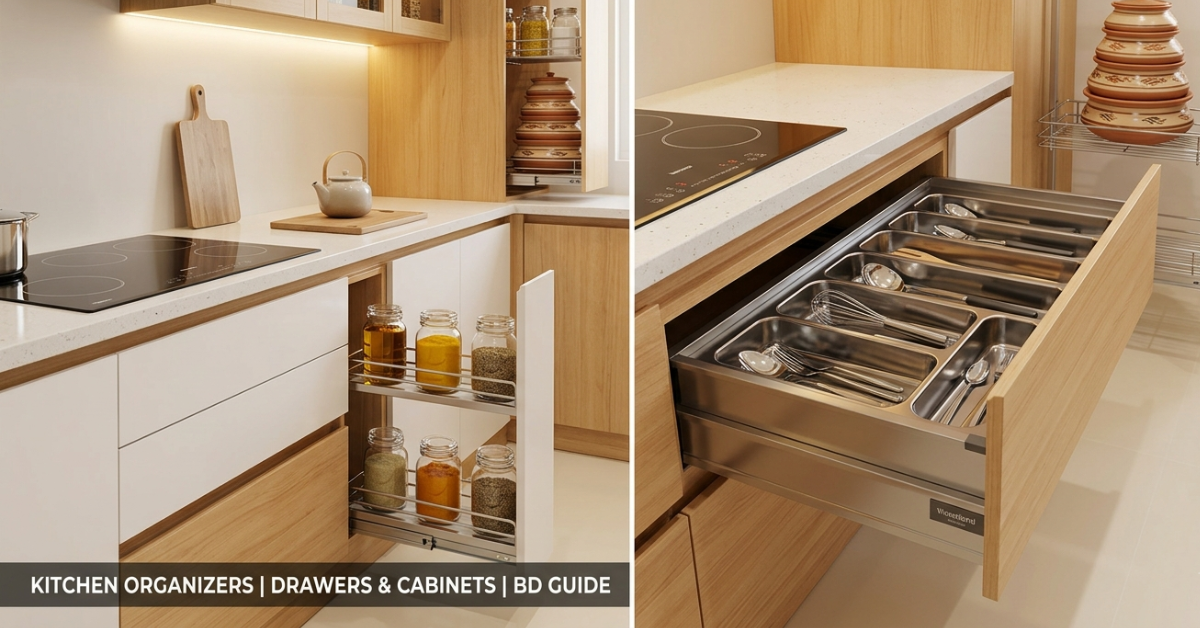
Managing an everyday Bangladeshi kitchen drawer separator requires a delicate balance between rapid meal preparation and heavy-duty storage handling. Between organizing mustard oil bottles, masalas, and daily cutlery, unorganized cabinets quickly degrade into chaotic, high-friction zones.
Implementing high-grade kitchen organizers for drawers and cabinets turns tight urban apartment spaces into seamless, ergonomic cooking environments built for longevity.
Core Specification Framework: Selecting Internal Storage Fittings
Kitchen Organizers for drawers and cabinets require aligning specific cabinet locations with specialized internal hardware engineered for local cooking habits and high humidity.
1. Shallow Upper kitchen drawer separator (Cutlery & Prep Tools)
Top drawers sit directly below prep counters and demand multi-compartment dividers to prevent small utensils from jamming mechanical channels.
- Function: Immediate access to knives, whisks, tea strainers, and everyday flatware.
- Material Standard: Food-grade ABS plastic inserts or perforated SS304 mesh trays that resist oil residues and allow quick wipe-down cleaning.
- Hardware Requirement: Full-extension, soft-close undermount runners rated for at least 25 kg load capacity.
2. Base Side kitchen drawer separator (Spice & Oil Storage)
Positioned adjacent to active gas burners or induction hobs, narrow vertical pull-outs eliminate countertop clutter while keeping cooking fats and dry spices within arm’s reach.
- Function: Vertical storage for heavy glass oil bottles, condiment jars, and daily spice containers.
- Material Standard: Heavy-gauge electro-polished stainless steel wire frames with removable solid drip trays.
- Hardware Requirement: Installing a heavy-duty side drawer basket with bottom-mounted synchronization tracks prevents side-to-side wobbling under unbalanced weight.
3. Deep Lower Drawers (Heavy Cookware & Cookers)
Lower cabinet tiers host large dekchis, heavy-bottomed karahi pans, and high-capacity pressure cookers that ruin traditional fixed wooden shelves.
- Function: Stacking bulky metal cookware and large serving platters without manual lifting into dark cabinet recesses.
- Material Standard: 6mm solid stainless steel wire construction with reinforced perimeter welds.
- Hardware Requirement: Heavy-duty double-wall metal drawer sides with hydraulic dampening channels rated for 45 kg to 60 kg dynamic loads.
4. Blind Corner Units (Reclaiming Dead Space)
L-shaped and U-shaped kitchen drawer separator for drawers and cabinet layouts create deep, inaccessible corner voids where moisture and pests accumulate.
- Function: Bringing hidden items out into full view via mechanical tray articulation.
- Material Standard: Anti-slip melamine tray bases framed by chrome-plated round steel guardrails.
- Hardware Requirement: Fitting a dynamic magic corner unit with soft-close dampeners ensures smooth dual-stage pull-out motion without jarring delicate glassware.
Technical Material & kitchen drawer separator
The high humidity, monsoon atmospheric moisture, and heavy spice usage common across Dhaka and Chattogram rapidly destroy sub-standard cabinet hardware.
Specifying industrial-grade raw materials prevents rust, door sagging, and premature rail seizure.
Steel Grade Classification: Grade 304 vs. Grade 201
Not all stainless steel hardware handles kitchen drawer separator for drawers and cabinet humidity equally.
- Grade 304 Stainless Steel:SS304 has 18% chromium & 8% nickel, resisting steam, salt & acid in moist Kitchen kitchen drawer separator for drawers and cabinet wire baskets.
Technical Pro Tip:Verify wire baskets via acid tests or certificates. SS304 is non-magnetic, while cheap chrome carbon steel attracts magnets and rusts in coastal air.
+———————————————————————–+
| KITCHEN CABINET ARCHITECTURE |
+———————————————————————–+
| UPPER TIER: LIGHTWARE STORAGE |
| [ Wall Dish Racks ] [ Glass Holders ] [ Hanging Spice Bars ] |
+———————————————————————–+
| COUNTERTOP WORKING ZONE |
| [ Prep Counter ] [ Built-in Gas Hob ] [ Deep SS Basin Sink ] |
+———————————————————————–+
| BASE TIER: HEAVYWARE MECHANICAL SYSTEMS |
| [ Cutlery Trays ] [ Side Spice Pull-Outs ] [ Heavy Pot Baskets ] |
| [ Magic Corner ] [ Tall Larder Units ] [ Under-Sink Bin ] |
+———————————————————————–+
Drawer Runner Systems & Load Bearing Mechanics
The longevity of any kitchen drawer separator for drawers and cabinets relies directly on the hidden mechanical channel mounted to the cabinet sidewall.
| Channel Type | Extension Style | Weight Rating | Best Application | Moisture Resistance |
| Telescopic Ball-Bearing | Side-Mount Full | 25 – 35 kg | Light spice racks & cutlery drawers | Moderate (Requires periodic grease) |
| Concealed Undermount | Bottom-Mount Full | 30 – 50 kg | Premium wooden drawer boxes & utensil trays | High (Mechanism hidden beneath drawer) |
| Double-Wall Steel Box | Integrated Metal Frame | 45 – 70 kg | Deep pot drawers & tall larder units | Exceptional (Powder-coated steel sides) |
Step-by-Step Layout kitchen drawer separator
Maximizing a compact 60-to-100-square-foot apartment kitchen requires systematically kitchen drawer separatorinternal cabinet capacity based on daily workflow.
1.Measure Clear Internal Cabinet Dimensions:Measure exact inner cabinet dimensions with a steel tape. Subtract 5mm depth for soft-close stops.
2.Map Plumbing, Gas Line, and Electrical ObstructionsCheck gas hoses, sink pipes & sockets before sizing drawers. Keep gas valves accessible for safety.
3.Establish Zone-Based Utility Allocations:Put cutlery trays under prep counters and oil pull-outs beside the stove to keep surfaces clear.
4.Install Synchronized Hydraulic Soft-Close Runners:Mount runners level and parallel with a spirit level so soft-close dampers catch without forcing.
Maximizing Vertical Volume with Tall Pantry Larder Systems
In tight spaces, vertical tall units turn narrow 300–400mm spaces into high-density pantries.
+———————————————————————–+
| VERTICAL TALL LARDER PULL-OUT STRUCTURE |
+———————————————————————–+
| [ Top Tier ] Bulk dry flour, extra rice bags, packaged snacks |
| [ Upper Middle ] Canned goods, carton milk, breakfast cereals |
| [ Lower Middle ] High-frequency daily spices, lentils (dal), oil refills|
| [ Base Tier ] Heavy storage jars, beverage bottles, surplus stock |
+———————————————————————–+
| Mechanical Specs: SS304 frame, soft-close top/bottom tracks, 80kg load|
+———————————————————————–+
Six-tier tall larders use top/bottom sliders. Pulling the door glides wire shelves out, exposing items from both sides and eliminating dark corners.
Common Storage Mistakes and How to Avoid Them
Even high-end kitchen renovations fail when hardware specifications do not match real-world daily demands.
Avoiding key structural mistakes saves money and preserves custom woodwork integrity over time.
1. Overloading kitchen drawer separator with Cast Iron and Brass
Traditional wooden drawer boxes constructed with basic 12mm plywood bottoms cannot support heavy brass handis or cast-iron cookware over extended periods.
- The Failure: Drawer bottoms sag, bow downward, and eventually break away from side grooves, while standard side-mount runners strip out mounting screws.
- The Fix: Replace wooden drawer bases meant for heavy cookware with full-wire SS304 baskets or double-wall steel drawer boxes rated for at least 50 kg dynamic loads.
2. Ignoring Ambient Moisture in Under-Sink Compartments
Plumbing connections inevitably experience micro-sweating or occasional drainage leaks.
- The Failure: Bare wood or low-quality particle board absorbs water, expands, rots, and attracts fungal growth and termites.
- The Fix: Line under-sink cabinet bases with waterproof aluminum foil matting and install anti-corrosive powder-coated pull-out racks or PVC drainage trays.
3. Purchasing Unbranded Hydraulic Soft-Close Hinges and Runners
Inexpensive, non-certified soft-close mechanisms rely on low-grade internal hydraulic fluid seals.
- The Failure: Hydraulic fluid leaks out within months due to temperature fluctuations, causing drawer fronts and cabinet doors to slam violently against frames.
- The Fix: Demand branded, cycle-tested hardware with certified corrosion-resistant coatings designed for humid climates.
Maintenance Protocols for Long-Term Hardware Performance
Maintaining mechanical kitchen kitchen drawer separator in tropical environments requires routine care to prevent grease buildup and smooth slider performance.
+———————————————————————–+
| QUARTERLY HARDWARE MAINTENANCE CHECKLIST |
+———————————————————————–+
| [ ] Clean Drawer Slides : Remove accumulated dust and food debris |
| [ ] Lubricate Bearings : Apply food-grade silicone spray to rails |
| [ ] Tighten Mounting Screws: Re-align front panel brackets & hinges |
| [ ] Wash Wire Baskets : Wipe SS304 surfaces with neutral detergent |
| [ ] Inspect Drip Trays : Empty water collection pans under racks |
+———————————————————————–+
- Wipe Down Wire Surfaces Monthly: Wipe wires with a damp microfiber cloth and soap. Avoid bleach or steel wool to prevent scratches.
- Re-Grease Mechanical Channels Bi-Annually: Brush dust and flour from slider tracks, then apply food-grade silicone spray for smooth gliding.
- Inspect Drawer Front Alignment Annually: Adjust front panel cam-screws on runners to fix height and tilt gaps from shifting wood.
Final Footer Block
Next Steps & Resource Directories
Browse Full Directories
[KitchenLink Hub] > [Storage Accessories]
Related Articles
- Top Pull Out Drawers for Wardrobes to Maximize Storage
- Pantry Pull Out Unit for Smart Kitchen Storage Solutions!!
- Pull Out Trouser Rack: Smart Wardrobe Storage Solutions
- Tall Pull Out Cabinet: Smart Kitchen Storage Solution
